Ulster County Environmental Management Council urge the DEC to adopt new regulations for onsite treatment and disposal of landfill leachate

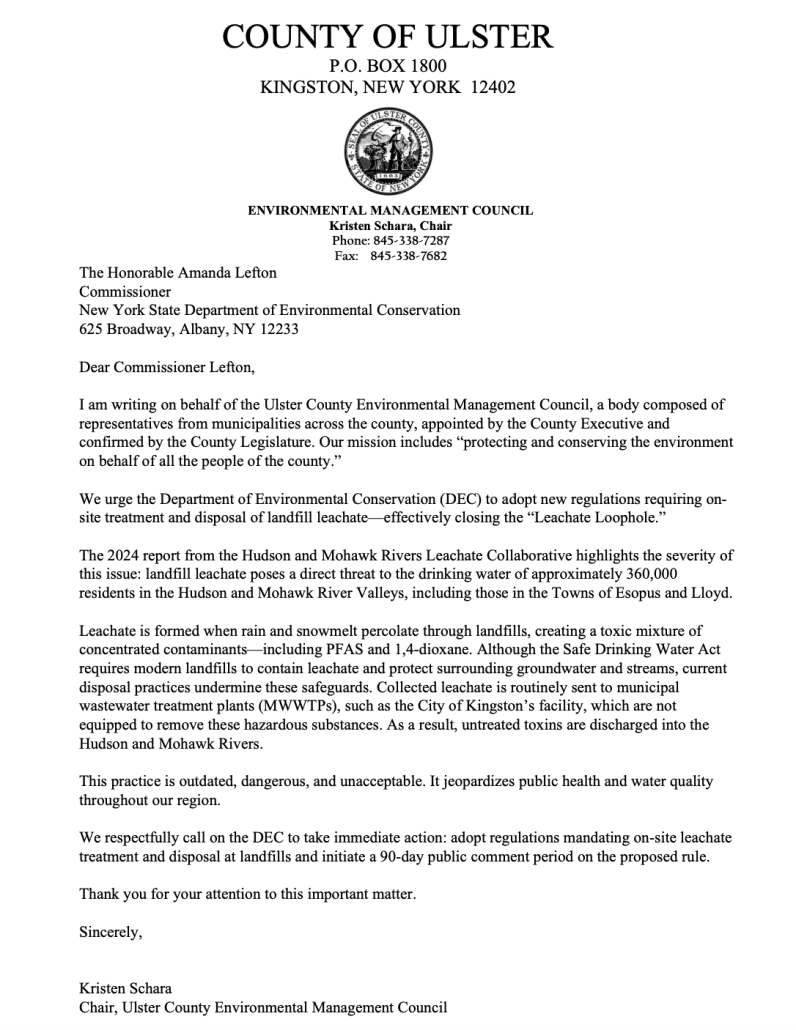
The Ulster County Environmental Management Council (EMC) has formally urged the New York State Department of Environmental Conservation (DEC) to take immediate action to protect public health and water quality by closing the “Leachate Loophole.”

The EMC is an advisory body made up of representatives from municipalities across Ulster County. Members are appointed by the County Executive and confirmed by the County Legislature. Its mission is to protect and conserve the environment on behalf of all the people of Ulster County.

In a letter recently approved by the Council, the EMC called on the DEC to adopt new regulations requiring on-site treatment and disposal of landfill leachate—the toxic liquid that forms when rain and snowmelt pass through landfill waste.

“Current practices are outdated and unsafe,” the EMC stated. “We need to stop sending this hazardous waste to municipal wastewater treatment plants that were never designed to handle it.”

Leachate often contains harmful contaminants like PFAS and 1,4-dioxane—chemicals linked to cancer and other serious health risks. Yet across New York State, this toxic liquid is still routinely sent to facilities such as the City of Kingston’s wastewater treatment plant, which cannot effectively remove these substances. The result: untreated toxins discharged into the Hudson and Mohawk Rivers.

The EMC’s call to action follows the 2024 report from the Hudson and Mohawk Rivers Leachate Collaborative, which found that leachate pollution poses a direct threat to the drinking water of approximately 360,000 residents, including those in the Towns of Esopus and Lloyd.

As a countywide council advocating for environmental protection and sustainability, the EMC urges the DEC to adopt regulations mandating on-site leachate treatment at landfills and to initiate a 90-day public comment period.

As EPA abandons drinking water protections, New York must step in with a precautionary approach

In June 2017, six months into the first Trump administration, Comptroller Thomas DiNapoli issued a report on drinking water regulation in New York State. Contamination crises in the Village of Hoosick Falls and City of Newburgh had exposed “significant gaps in protections,” and in response, his office analyzed federal and state roles in drinking water regulation. With EPA planning to deregulate and defund environmental programs, DiNapoli advised NYS to act independently. To this end, he suggested “adoption of a more precautionary approach to regulating contaminants.”

Now, months into a second Trump administration, EPA has announced its intention to roll back recently adopted drinking water standards for per- and polyfluoroalkyl substances (PFAS) – the very standards that were designed to protect people from the type of drinking water pollution that people in Hoosick Falls and Newburgh experienced. Nor will the administration defend the standards in court. The administration’s 2026 budget eliminated funding for drinking water infrastructure, leaving only 10% as an “offramp.” As if that’s not enough, EPA has restructured its science division to speed up new chemical approvals, a process that doesn’t even require companies to test chemicals for safety before putting them on the market.

In 2017, given anticipated EPA funding cuts, the NYS Comptroller questioned “EPA’s ability to implement the SDWA effectively.” Today, the answer is clearly “no,” and furthermore, the central question seems to be whether EPA’s leadership even has the will to do so.

So what should New York do?

The suggestion put forth eight years ago by Comptroller DiNapoli is still on point: New York State must adopt a precautionary approach to drinking water regulation. The “precautionary principle” means that when pollution and its attendant harms are reasonably likely to occur, regulators step in to prevent damage before it occurs, even if questions remain. Lingering questions must be addressed before a potentially polluting action moves forward. In contrast, our existing environmental laws kick in after damages occur. People who are harmed by pollution must prove it before chemical restrictions are considered. If restrictions are deemed necessary, developing them requires years of extensive data collection and analyses.

Our lack of precaution has given rise to a vast group of chemicals called “emerging contaminants,” a catch-all title covering chemicals that are suspected to be harmful, but whose risks and exposures are not fully defined. Despite what the name suggests, emerging contaminants aren’t necessarily new. For example, PFAS production began in the 1940s, causing pollution on a global scale – with severe impacts in multiple New York communities – before the public even began to learn of the threats.1

Landfills are time capsules of industrial, commerical, and municipal waste, which release a toxic soup of contaminants as rainwater percolates through them. Modern landfills are required to be lined with impermeable barriers so that leachate does not leak out and pollute neighboring ground- and surface water.2  Instead, the liquid is collected by a network of drainage pipes underneath the landfill. But, despite all the infrastructure to contain and control leachate at landfill sites, the standard practice is to pump it into tanker trucks and haul it to sewage treatment plants, which are not equipped to remove the synthetic chemicals that make leachate dangerous. As a result, they pass through sewage plants into surface waters, including drinking water supplies.

Allowing low levels of polluting chemicals to be dumped into our drinking water is a misguided and unacceptable risk. Some emerging contamiants are bioaccumulative, persistent, and/or harmful in very low doses. PFOA and PFOS, the two best-studied PFAS, are a case in point: EPA’s drinking water standards aim for zero detectable amounts of these compounds in treated drinking water, because no safe level of exposure exists.

Landfill leachate is known to be toxic – this is the very reason that landfills contain and collect it. Yet, regulatory loopholes allow it to be dumped, untreated, into surface waters.A precautionary approach to leachate disposal, one that stops leachate disposal at sewage treatment plants, would put NYS on a better path with regard to drinking water safety.


TAKE ACTION 
Urge The NY Department of Environmental Conservation (DEC) to Adopt New Regulations for On-site Treatment and Disposal of Leachate at Landfills

Subscribe to our newsletter!

Please consider any size donation to our work
 

1 To learn about how this affected people in Hoosick Falls and other parts of New York, read They Poisoned the World by Mariah Blake.

2 New York State’s ongoing investigation into drinking water pollution from older, unlined landfills shows how real of a threat this is: PFOA or PFOS concentrations in groundwater are above NYS standards at 68% of the landfills that have been tested.

Bearing Witness in Brookhaven, NY: A Visit with Monique Fitzgerald of BLARG (Brookhaven Landfill Action and Remediation Group)

By Rebecca Martin

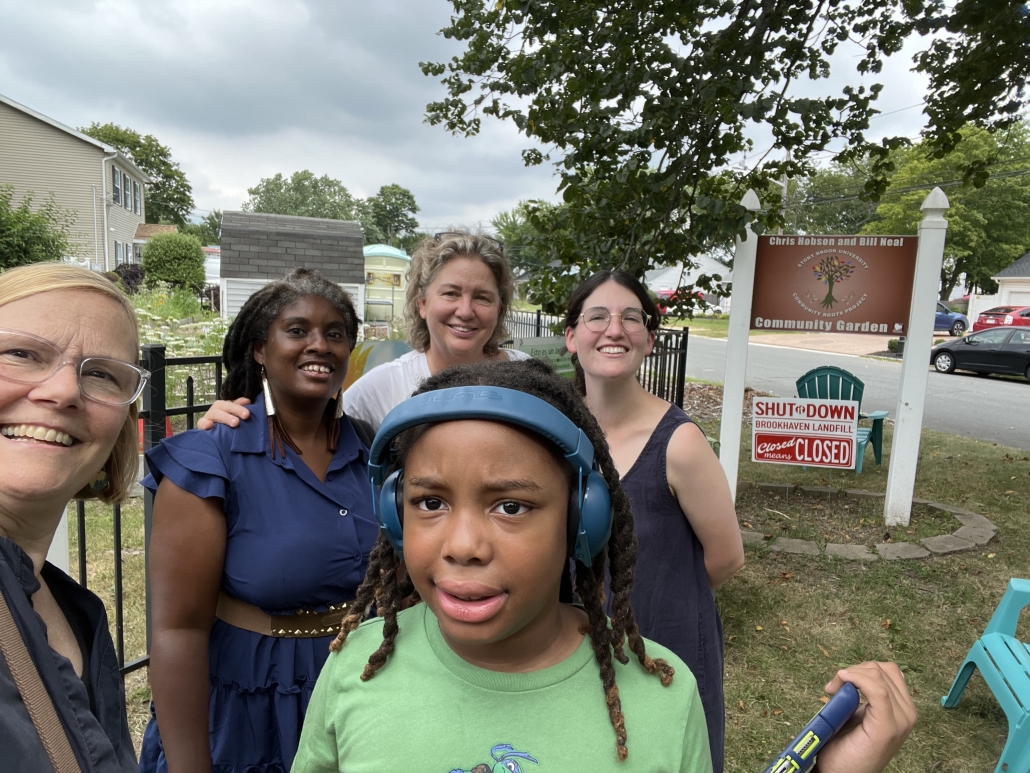
This summer, a small group of advocates—including Rhonda Keyser, a talented artist, Program and Policy Director at Cafeteria Culture  and member of the Brooklyn Solid Waste Advisory Board, Natalie Russianoff, Program Assistant at Beyond Plastics; and myself—traveled to Brookhaven, NY (North Bellport) to visit Monique Fitzgerald, co-founder of BLARG (Brookhaven Landfill Action and Remediation Group). Visiting coalition partners in person to see the work they are doing and the harms they face is a crucial part of advocacy—what many call “ground truthing”—to truly understand the lived realities behind environmental justice struggles. 

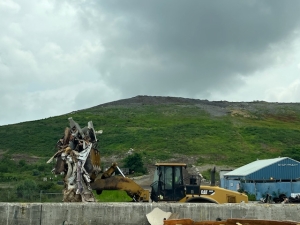
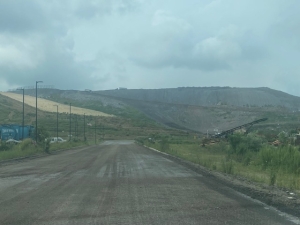
Monique and her nephew welcomed us with incredible warmth and generosity at their community garden, then walked us through the neighborhoods that lie in the shadow of the Brookhaven Landfill. What we witnessed was deeply sobering. From towering mounds of incinerator ash and construction debris to the constant drone of truck traffic, it was impossible to ignore the scale of harm being done here. This landfill is not just a source of pollution—it is a symbol of systemic neglect.

BLARG is a resident-led direct action group rooted in Brookhaven/North Bellport, a predominantly Black and Latino neighborhood adjacent to the landfill. The organization is focused on protecting residents’ health, demanding accountability from local and state governments, and ultimately shutting down the landfill. Monique Fitzgerald herself is a tireless advocate who never shies away from a fight or from helping others. She frequently travels to Albany to speak about the harms facing her community and ensure their voices are heard.

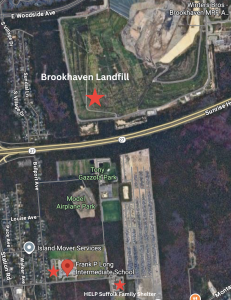
The Brookhaven Landfill has a notorious history of environmental violations. It receives waste from all across Long Island, including highly toxic incinerator ash. This site has been linked to toxic groundwater contamination, including PFAS chemicals, persistent air pollution, and noxious odors that make daily life difficult for nearby residents. The largest source of incinerator ash deposited at the landfill comes from the Reworld Hempstead facility (formerly Covanta Hempstead) in Uniondale, NY. This so called “waste-to-energy” incinerator burns municipal garbage and produces between 500 and 750 tons of ash each day, including fly ash and bottom ash that contain heavy metals and other hazardous pollutants. A 2024 state review found violations in how this ash is handled and tested, yet trucks continue to haul tons of this toxic byproduct into a landfill surrounded by homes, schools, and playgrounds.

Just about 2 miles from the landfill sits Frank P. Long Intermediate School, widely known in the community as the “Sick School”. As of 2019, out of 105 staff members, about one-third have been diagnosed with cancer, and 18 have died. Meanwhile, HELP Suffolk, a family shelter operated by Help USA, provides temporary housing for roughly 76 families experiencing homelessness just next door of the school.  The co-location of a shelter, a contaminated landfill, and a school paints a stark picture of systemic neglect and environmental injustice in the area.

The broader landscape surrounding the Brookhaven Landfill reveals the cumulative impact of decades of harmful land use decisions. In addition to the landfill itself, the area is marked by widespread clear-cutting for industrial warehouse development, a power plant, a county jail, and major truck corridors. These patterns did not arise by chance; they likely reflect long-standing discriminatory planning practices that prioritize industrial infrastructure over the health and wellbeing of low-income communities.

This failure of good planning is reinforced by the fact that the Town of Brookhaven’s last Comprehensive Land Use Plan was adopted in 1996—almost 30 years ago. However, in May 2025, the town issued a Request for Proposals to develop a new town-wide Comprehensive Land Use Plan. This upcoming planning process presents a critical opportunity for residents to shape the future of their community. If done well, a Comprehensive Land Use Plan should reflect the values, needs, and vision of the people it serves. For North Bellport and other frontline communities, it could become a powerful tool in the broader fight for environmental justice, ensuring that future land use decisions protect rather than harm their neighborhoods.

The strength, resilience, and determination of Monique, her family, and the North Bellport community is inspiring. Their fight is far from over, but with continued support, advocacy, and awareness, change is possible.

How to Provide Support

  • Donate to BLARG: Contributions—whether one-time or recurring—help sustain this grassroots movement and support the frontline work being led by residents of North Bellport.
  • Stay Informed: Follow BLARG  to stay updated on developments in the fight against the Brookhaven Landfill.
  • Advocate for Planning Justice: Residents of Brookhaven and the surrounding region are encouraged to engage with the upcoming Comprehensive Land Use Plan process. Ask local officials how the public will be included and demand meaningful, inclusive community participation.
  • Share the Story: Help lift up this fight. Talk to your friends. Share this blog. Invite others to learn more.

###

Rebecca Martin is an advocacy consultant who serves as Project Manager of the Leachate Loophole, Director of Community Partnerships and Training at Beyond Plastics, and Source Water Protection Coordinator for the Hudson River Drinking Water Intermunicipal Council (Hudson 7).  She is also lead strategic advocate and writer for KingstonCitizens.org.

Albany Times Union (Sunday): “What’s in Colonie’s drinking water?”

There was a great letter to the editor in this weekend’s Albany Times Union:

What’s in Colonie’s drinking water?
Albany Times Union (Sunday)
27 Jul 2025

Although it is illegal to discharge landfill leachate directly into waterways, state law allows this poisonous concoction to be piped through municipal sewer systems and then into waterbodies, including the Mohawk and Hudson rivers. There are financial incentives for towns to accept this poisonous waste, including disposal fees that the landfill pays.

Most Colonie and Cohoes residents obtain their household water from the Mohawk. We’d like to know what’s in our drinking water.

Luckily, the state Environmental Facilities Corporation offers grants to determine whether leachate poses a danger to our primary water supply and, if so, to fund a remedy.

In February, our good-government organization, SAVE Colonie: A Partnership for Planning, brought this issue to the attention of Colonie Supervisor Peter Crummey and the Town Board by letter and by in-person public comment at the Feb. 13 board meeting. We also provided information about the EFC grants program. We suggested the town urge the state to eliminate this leachate loophole.

Since then, the silence from our elected officials has been deafening.

Over the past two years, there have been several townwide boil-water advisories and numerous water main breaks due to aging infrastructure. As summer advances, lower Mohawk water levels concentrate pollution, making water safety more concerning.

On behalf of Colonie residents, we ask our government to provide accurate, detailed data on the chemical content of our primary water supply and outline its plans to provide safe water if the Mohawk.

Fred Pfeiffer
Albany

Buffalo News: “As feds roll back PFAS regulations, New York needs to step up”

We’re pleased to share an op-ed published in today’s Buffalo News, co-authored with one of our key coalition partners, Yvonne Taylor of Seneca Lake Guardian.  Special thanks to Meg Fitzgerald of BerlinRosen for her support and assistance.


ANOTHER VOICE | PUBLIC HEALTH
Another Voice: As feds roll back PFAS regulations, New York needs
to step up

Yvonne Taylor, Rebecca Martin and Jen Epstein

Jun 19, 2025

The Trump administration’s latest rollback of regulations on PFAS – “forever
chemicals” linked to cancer, immune system damage, developmental issues,
and more – is especially dangerous. These compounds never break down in the
environment, and they’re turning up in drinking water supplies across the country,
including here in New York. Landfills are a major contributor of PFAS. When
rainwater and runoff filters through mountains of waste at landfills, it produces
leachate, a toxic cocktail of dozens of chemicals, including PFAS.

Seneca Meadows Inc. (SMI), the state’s largest landfill, produces 200,000 gallons of
this poison every day. SMI trucks most of its leachate to wastewater treatment plants
across New York and even out of state. The Bird Island treatment facility just north of
Buffalo accepted over 32 million gallons of this leachate in 2023 alone. These
facilities are not equipped to remove PFAS and other synthetic chemicals from all the
leachate they accept. They discharge it right back into our rivers, lakes, and
groundwater – untreated.

A recent report found that about 89 million gallons of landfill leachate were
discharged into the Mohawk River and Hudson River Estuary annually from 2019 to
2023. We’re poisoning our drinking water with our own garbage.
The volume of leachate coming from Seneca Meadows could grow. The landfill is
planned to reach capacity and close at the end of this year, but Waste Connections is
applying for a new permit . The decision to shut down the landfill once and for all
remains with the Department of Environmental Conservation.
Seneca Meadows is the poster child of the harmful throwaway culture that New York
should be fighting to move beyond, not grow. New York needs to treat landfill
leachate as the serious threat to human and environmental health that it is.

It’s time to ban the discharge of landfill leachate into municipal wastewater systems,
require landfills to treat leachate for the full range of contaminants , and set legally
enforceable drinking water standards .

As Washington fails us, Albany must rise to the moment.

Yvonne Taylor is a co-founder and vice president, Seneca Lake Guardian; Rebecca
Martin is a project manager and Jen Epstein is a data analyst and lead writer for
the Hudson and Mohawk Rivers Leachate Collaborative

Definition of “Treatment”


Shortly after we published our report, we needed to use different terminology to refer to the facilities that process sewage. In January, we began to use the term Sewage Treatment Plant (STP) rather than Wastewater Treatment Plant (WWTP). We did this because “Wastewater Treatment Plant” implies that these facilities treat a broad range of wastes. They don’t. They are designed, managed, and regulated to treat domestic sewage.

Recently, Laura Orlando, Senior Scientist at Just Zero, delivered a presentation on landfill leachate treatment technology to our coalition. Her presentation raised the very important question of what the term “treatment” means. Laura shared a list of three guiding questions that can be used to clarify what it means to “treat” a waste stream and understand what a treatment approach offers. They are:

  1. What are the goals of the treatment?
  2. How are we going to evaluate the treatment’s effectiveness?
  3. What substances are we treating for?

It was by thinking about these types of questions that our collaborative first identified the Leachate Loophole, and later these same types of questions helped us realize the need to shift our language from “wastewater treatment plants” to “sewage treatment plants.” The goal of an STP is to treat human waste. It is evaluated based on its effectiveness at removing or reducing a few chemical and biological substances that are indicators of human waste. The answers to Laura’s questions explain why landfill leachate shouldn’t be sent to these facilities.

In New York State, the Department of Environmental Conservation (DEC) in 2023 announced its intention to open a rule-making on onsite leachate treatment and disposal. Recent NYS guidance on PFOA, PFOS, and 1,4-Dioxane were DEC’s springboard for that action. Our collaborative has also engaged with municipalities such as the Town of Hurley and City of Kingston to address leachate disposal, and those conversations have centered on PFAS. As a preamble to her presentation, Laura pointed out that the current conversation about leachate treatment is already limited to PFAS, ignoring potentially thousands of chemicals that are present in landfill leachate. This fact isn’t usually laid clear, because the term “leachate treatment” is used, rather than something like “PFAS removal.”

Developing more responsible ways of managing landfill leachate is not a trivial process, and is not merely a question of what to do about PFAS. Even as we take steps forward to improve leachate treatment, we need to take a step back and ask whether our system of dumping waste into landfills can continue to serve us at all. Will it ever be possible to design and fund leachate treatment systems that truly neutralize the thousands of chemicals currently buried in landfills? Is it feasible to expect that we can produce a treated leachate that supports healthy rivers and drinking water supplies?

Our landfills will be around for the forseeable future, and will discharge toxic chemicals for decades. It is utterly essential that we develop the best leachate treatment systems we possibly can. But we can’t stop with that. We must also do as much as we can to reduce leachate flows by closing landfills.


TAKE ACTION 
Urge The NY Department of Environmental Conservation (DEC) to Adopt New Regulations for On-site Treatment and Disposal of Leachate at Landfills

Subscribe to our newsletter!

Please consider any size donation to our work
Rebecca Martin to Be Honored with Stewardship Award by Woodstock Land Conservancy

The Woodstock Land Conservancy (WLC) will honor Rebecca Martin, project manager of the Leachate Loophole and a longtime Hudson Valley environmental advocate, with the William R. Ginsberg Stewardship Award at its 13th annual Vernal Fling on May 17 at White Feather Farm in the Hudson Valley.

Martin, known for her leadership with KingstonCitizens.org, Kingston Land Trust, and Hudson Riverkeeper, has spent over 20 years protecting the region’s natural resources. She played a key role in blocking Niagara Bottling’s proposed water deal in Kingston and recently managed the Leachate Loophole report on landfill pollution.

WLC praised Martin for her passion, community organizing, and dedication to civic engagement. “It’s especially meaningful to be honored by WLC,” said Martin. “They’ve been a steady partner in this work for over a decade.”

Also receiving the award are Ken Greene and Doug Muller, co-founders of Hudson Valley Seed Company, recognized for their innovative and sustainable approach to seed saving and organic farming.

Tickets for the Vernal Fling are available at woodstocklandconservancy.org/vernalfling.

(Photo Credit: The Wall Street Journal)

Towns in Ulster County early response to the Leachate Loophole report


It’s encouraging to see the impact of our Leachate Loophole report. After reviewing our report, the City of Kingston, located in Ulster County, NY,  stopped accepting leachate from the Town of Hurley’s Superfund landfill—prompting important conversations and progress. We helped connect the town with engineers working on onsite treatment technologies, including one system we recently visited that removes up to 18 PFAS chemicals.

While it’s a step forward, our goal remains: we want technologies that can treat toxic leachate to potable standards. Waste systems took decades to build, and solutions will take time too. Recognizing how landfills and drinking water are connected is progress in itself.

We applaud both the City of Kingston Mayor Steve Noble and Town of Hurley Supervisor Mike Boms for their swift response and leadership.

(Photo: StreamGo system set up in the Town of Hurley.  Credit: Rebecca Martin)


TAKE ACTION 
Urge The NY Department of Environmental Conservation (DEC) to Adopt New Regulations for On-site Treatment and Disposal of Leachate at Landfills

Subscribe to our newsletter!

Please consider any size donation to our work


Hudson and Mohawk Rivers Leachate Coalition Hosts Riverkeeper Attorney on Rulemaking

In April, the Hudson and Mohawk Rivers Leachate Coalition hosted Drew Gamils, Senior Attorney at Riverkeeper, for a presentation on the New York State rulemaking process. The session was timed to prepare coalition partners for an upcoming rulemaking proposed by the NYS Department of Environmental Conservation since 2023, which aims to address the critical issue of “onsite treatment and disposal of leachate at landfills.”

The Hudson and Mohawk Rivers Leachate Collaborative continues to press the state for new regulations to close the “leachate loophole”. This loophole currently allows toxic landfill leachate to be sent to municipal sewage treatment plants that are ill-equipped to handle it. As a result, harmful substances are discharged into rivers that serve as drinking water sources for communities across the state, posing significant risks to both public health and the environment.

 “Behind the Rules: How New York Makes the Law Work” with Drew Gamils, Riverkeeper.   

In May, the group will host Laura Orlando, Senior Scientist at Just Zero, who will present an “Overview of Landfill Leachate Treatment for Toxic Chemicals” to the Coalition. 

If you’re an organization interested in joining the coalition, please contact us at Contact Page.


TAKE ACTION 
Urge The NY Department of Environmental Conservation (DEC) to Adopt New Regulations for On-site Treatment and Disposal of Leachate at Landfills

Subscribe to our newsletter!

Please consider any size donation to our work
Ulster County Legislature Urges State to Regulate Landfill Leachate Treatment

In a unanimous April vote, the Ulster County Legislature passed a resolution urging the New York State Department of Environmental Conservation (DEC) to initiate a rulemaking process to establish new regulations under 6 NYCRR Parts 360 & 363 for the onsite treatment and disposal of landfill leachate.

The resolution was sent to key state officials, including Acting DEC Commissioner Amanda Lefton, legislative environmental chairs, and all Ulster County state representatives. The letter cited the 2024/2025 report by the Hudson and Mohawk Rivers Leachate Collaborative, which highlights serious regulatory gaps that allow untreated landfill leachate to be processed at municipal sewage treatment plants, facilities that discharge directly into the Hudson and Mohawk Rivers, drinking water sources for roughly 368,000 people, including 10,000 in Ulster County.

Ulster County joins County Executive Jen Metzger, the Hudson and Mohawk Rivers Leachate Collaborative, and others in calling for immediate action and a 90-day public comment period to ensure robust public engagement in shaping these critical environmental protections.